
Ambulance Operations Management in South Africa
An ambulance in South Africa is three things at once: a licensed health service vehicle, an emergency vehicle under road traffic law, and mobile clinical equipment that can be inspected at any time. This guide covers what that means day to day, from the DoH inspection checklist and vehicle registration to equipment, dispatch, infection control and crew scheduling.
DoH ambulance inspection checklist for South Africa
Before a provincial Department of Health licenses an ambulance service, and again at every annual renewal, an inspecting officer checks the station, the vehicles, the staff and the equipment against Annexures A and B of the 2017 EMS Regulations. No licence is issued until the service passes. The checklist below follows those annexures.
Use your province's form as the final word. Provinces inspect against the same regulations but use their own inspection forms. Ask your provincial EMS licensing office for its current form before the inspection date.
Service and station
Staff
Each ambulance
Equipment (Annexure B)
Annexure B lists the minimum equipment per level of care under these headings. Check every item is present, working and in date.
| Airway equipment | Endotracheal intubation |
| Breathing and ventilation | Oxygen supply |
| Ventilator | Diagnostic and therapeutic equipment |
| Disposables | Intravenous therapy |
| Medicine sundries | Transport and immobilisation |
Extra lists apply to MICU and neonatal transfers and to rescue vehicles.
Documents on the day. Have the licence displayed at your main station, a valid licence token on every licensed vehicle, and roadworthy certificates, licence discs, maintenance logs, cleaning logs and the waste disposal contract ready. The per-vehicle document list is in the licensing section below.
Vehicle categories and legal definitions
Each vehicle has to be categorised, registered and licensed correctly under road traffic law and the EMS Regulations before it's deployed. Each category has its own staffing, equipment and paperwork. Get the category wrong and every claim from that vehicle is at risk.
Patient transport
Ambulance
Under the National Road Traffic Act 93 of 1996, an ambulance is a vehicle built or adapted to carry sick or injured people for medical treatment and registered as an ambulance on eNaTIS.
It needs at least two crew, full crew access to the patient compartment in transit, and a BLS, ILS or ALS designation based on crew and equipment.
Rapid response
Medical response vehicle
A non-transporting vehicle, often staffed by a single ALS practitioner, sent to high-acuity calls to get a clinician on scene quickly. It must be listed on your provincial licence like any ambulance.
It needs at least one crew member. A service may not run more response vehicles than ambulances unless it has agreements with other accredited providers.
Technical rescue
Medical rescue vehicle
Equipped for reaching and freeing patients who are trapped or confined, for example in a vehicle wreck. It needs at least two crew and the rescue equipment the regulations list for rescue operations.
"Ambulance" means an appropriately equipped vehicle which is either airborne, or land-based and designed or adapted for the purpose of providing emergency care and the transportation of user which is licensed to an EMS registered, staffed and equipped in terms of the EMS Regulations, published in the Government Gazette of 1 December 2017.
Standards for Emergency Medical Services, GN R2819, 2022Every vehicle is licensed individually. A vehicle running as an ambulance without its own entry on your provincial licence and its own licence token is operating outside the law, and claims from it will be rejected.
Fleet licensing and registration
Registering an ambulance on eNaTIS
Every ambulance must be registered as an ambulance on the Electronic National Traffic Information System (eNaTIS). A converted vehicle is first registered and made roadworthy as a standard vehicle. After the conversion it's inspected again and re-registered in the ambulance category.
Converted vehicles may also need a conversion certificate and a weighbridge certificate showing the new tare mass. Check with your registering authority what it needs before the conversion is finished. The application forms, including the ACR for roadworthiness and the RLV for registration and licensing, are on the eNaTIS website.
Provincial licence and licence tokens
On top of eNaTIS registration, each vehicle is listed on your provincial EMS licence and gets its own licence token, which must be displayed on the vehicle. Licences and tokens last 12 months and are renewed after a fresh inspection. The EMS Management Guide covers the full licensing process and fees.
Report every fleet change to the provincial licensing authority, whether it's an addition, disposal or replacement. If you're on the GEMS network, tell the GEMS Network Management Team too.
Don't deploy a new vehicle before its token arrives. Until the vehicle is on your licence and the token is on the windscreen, neither the province nor medical aids, GEMS included, will treat it as a licensed ambulance.
Fleet register: documents per vehicle
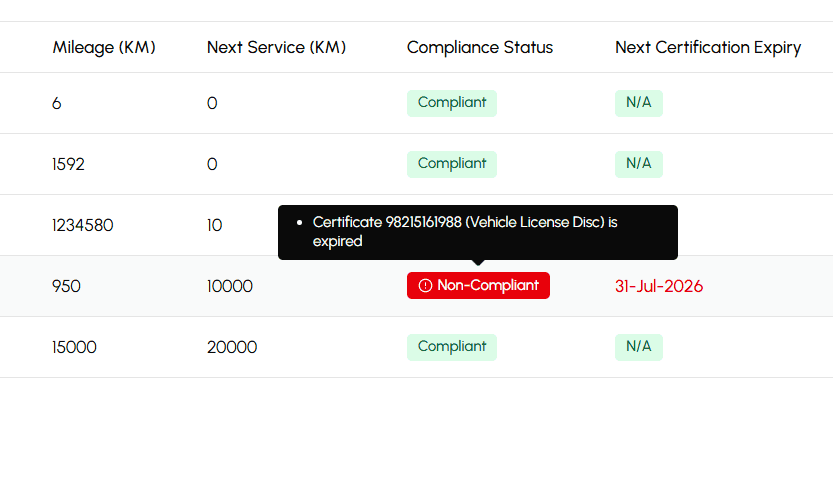
Keep a fleet register with these documents for every vehicle, ready for any OHSC, provincial or GEMS inspection.
Roadworthiness requirements for ambulances
Roadworthiness isn't a once-off certificate. The National Road Traffic Act and the EMS Regulations both require the vehicle to be roadworthy every time it's in service. An incident in an unroadworthy ambulance creates serious medico-legal and civil liability.
What the roadworthy test covers
Tests are done at accredited testing stations, which you can find through the eNaTIS website. Ambulances get the standard checks plus checks on the emergency conversion.
| Component | Requirement |
|---|---|
| Brakes | Working on all axles, with a working handbrake |
| Lights and indicators | All working, including warning lights to the legal specification |
| Tyres | Above minimum tread depth, no structural damage |
| Windscreen | No damage that blocks the driver's view, working wipers |
| VIN and engine numbers | Match the registration papers, no tampering |
| Siren | Fitted, working and to the prescribed sound specification |
| Patient compartment | Full crew access, equipment mountings secure |
| Body and chassis | No damage or rust affecting structural strength |
Section 60 of the National Road Traffic Act lets the driver of an ambulance exceed the speed limit on duty, but only with the siren sounding and the warning light on, and with due regard for the safety of other road users.
Staying roadworthy between tests
A roadworthy certificate only proves the vehicle passed on the day. You're responsible for it being roadworthy every time it goes out, so run a documented vehicle check before every shift. Log any defect, take the vehicle out of service if the defect affects safety, and only return it once the repair is signed off.
An unroadworthy ambulance creates liability on several fronts. It's a road traffic offence, a negligence risk if a patient is harmed in transit, a breach of your licence conditions and a GEMS network transgression if an inspector finds it.
Pre-shift vehicle check
How to standardise an ambulance fleet
Standardising a fleet means every vehicle at the same level of care is set up the same way: same base vehicle where possible, same conversion, same equipment layout and the same check sheet. Crews can then move between vehicles without hunting for kit, and one inventory list covers every unit at that level.
Layout
One layout per level of care
Store each Annexure B item in the same place in every BLS, ILS or ALS vehicle. A crew member who grabs the suction unit in the dark shouldn't have to think about which ambulance they're in.
Checks
One check sheet per level
Build the pre-shift and inventory checks from the same list, in the same order as the layout. Missing items show up faster, and inspection prep becomes routine.
Vehicles
Fewer vehicle and conversion types
A smaller mix of base vehicles and conversions means shared spares, simpler maintenance schedules and fewer surprises at the roadworthy test.
Records
One register for the whole fleet
Keep licensing, service intervals, certificates and equipment for every vehicle in one register, so a lapse on any unit is visible to the whole management team.
Equipment standards by level of care
Annexure B of the EMS Regulations sets the minimum equipment for each level of care, and GEMS inspections check it too. Expired medicines, broken electrical equipment and missing consumables are among the most common findings. Small shortfalls can often be fixed on the spot. Major ones, like a broken defibrillator or no drug safe, can get you suspended from the GEMS network.
Equipment management
Keep an inventory per vehicle
List every required item with its condition, service or calibration date and expiry date. Update it whenever something is replaced or serviced.
Track expiry dates ahead of time
Expired consumables, even non-drug items, are an inspection finding. Flag items before they expire, not when an inspector finds them.
Service electrical equipment on schedule
Defibrillators, monitors, suction units and pulse oximeters need servicing and calibration on the manufacturer's schedule. Non-working electrical equipment is a GEMS major transgression.
Keep the controlled medicine register
ALS vehicles carrying scheduled medicines need a locked drug safe and a register of every administration, per vehicle, that reconciles with the PRFs.
Secure and record oxygen cylinders
Cylinders must be held in brackets in the vehicle and stored safely at the base. Unsecured oxygen is a GEMS moderate transgression. Record pressure and hydrostatic test dates.
Typical equipment by level of care
| Level | Typical equipment |
|---|---|
| BLS | AED, suction unit, oxygen and delivery devices, immobilisation equipment, basic airway adjuncts, wound care, stretcher with restraints |
| ILS | Everything on BLS, plus IV access and fluid therapy equipment and the medicines within ILS scope |
| ALS | Everything on ILS, plus a defibrillator/monitor, advanced airway and intubation equipment, the full ALS medicine formulary, and a locked drug safe with a controlled medicine register |
A summary only. The binding list is Annexure B of the 2017 EMS Regulations.
Clinical guidance: the EMSSA Practice Guidelines cover equipment standards, resuscitation, defibrillation, major incidents and patient handover.
Dispatch operations and response time standards
The 2022 EMS Standards require every service to run a coordinated dispatch system and to monitor response times at every stage of a call. For private services this is an operating requirement that inspectors will ask about, and it matters in billing disputes too.
What the Standards require of dispatch
Under the 2022 Standards, a service must:
Emergencies must be responded to in a co-ordinated and efficient manner by the EMS. The EMS must monitor response times for each stage of the call management and dispatch process.
Standards for Emergency Medical Services, GN R2819, 2022National response time targets
The national targets measure the time from the call being received to the first vehicle arriving on scene. In urban areas, 90% of Priority 1 (high-acuity) incidents should be reached within 15 minutes, and all other incidents within 60 minutes.
| Target | Urban standard |
|---|---|
| Priority 1 incidents | 90% within 15 minutes |
| All other incidents | Within 60 minutes |
As reported in the South African Medical Journal, 2015.
For a private service, response time data does two jobs. Internally it shows where the operation is slow. Externally it supports the medical necessity of a call when a medical aid questions it. Either way, it has to be captured at the time, not reconstructed from memory afterwards.


Infection prevention, control and waste management
Infection control in an ambulance is a clinical duty and an inspection item. Both the licensing inspection and GEMS inspections look for written cleaning schedules, PPE and a proper clinical waste process.
Vehicle and equipment decontamination
Decontaminate the patient compartment after every patient and at the start and end of each shift, and write it down. Inspectors ask for the cleaning log. A clean vehicle with no log is still a finding.
Each log entry should record the date, time, vehicle, products used and who did it. Keep the logs for a set period that fits your POPIA retention policy.
Maintain documented cleaning or disinfection schedules for vehicles, equipment, and base facilities. Provide appropriate Personal Protective Equipment for all staff. Segregate clinical and general waste; maintain proper disposal contracts with external service providers where required.
GEMS 2026 EMS Provider Guide, pre-inspection planningThe base
The base needs rest facilities, clean ablutions, a vehicle wash area with medical waste traps and a dirty utility for cleaning equipment. These are licensing requirements under Annexure A, not extras.
Clinical waste
Sharps, soiled dressings, used IV lines and anything that has touched blood or body fluids is hazardous waste. It has to be kept apart from general waste and removed by a registered hazardous waste contractor.
Crew exposure to blood and body fluids is also an occupational health issue. See the OHS guide for the Hazardous Biological Agents Regulations and needle-stick reporting.
Crew scheduling and shift compliance
Every shift you roster has a regulatory side. The patient attendant must match the vehicle's licensed level of care, rest periods under the Basic Conditions of Employment Act apply, and a crew member with lapsed HPCSA registration can't work that shift, legally or for billing.
Matching qualifications to vehicles
An ALS ambulance needs a Paramedic, ECT or ECP as patient attendant. Putting a BLS-only practitioner in that role is a GEMS major transgression, and claims from that vehicle will be declined. When someone calls in sick and the cover can't staff the vehicle at its level, run it at a lower licensed level or take it off the road.
ALS means a level of care provided within the Paramedic, Emergency Care Technician or Emergency Care Practitioner scope of practice as determined by the Health Professions Council of South Africa in terms of the Health Professions Act, 1974.
Standards for Emergency Medical Services, GN R2819, 2022Driver's licences and PDPs
Anyone driving a patient-carrying vehicle needs a professional driving permit (PDP) as well as the right licence code for the vehicle's gross vehicle mass. Most ambulances up to 3,500kg need a code B (the old code 8). Heavier vehicles, up to 16,000kg, need code C1 (the old code 10). Keep both on file and track the PDP's expiry, because it has to be renewed.
Checking HPCSA registration before deployment
Every crew member needs active HPCSA registration on the day they work. A system that holds each person's registration and flags lapses before the roster goes out is the only reliable check once you have more than a handful of staff.
Roster checklist
Before a roster is published, confirm for every shift:

Key reference documents
The primary sources behind this guide. Keep them where your operations team and compliance lead can reach them.
Licensing and inspection rules, with Annexure A for station, staffing and vehicle requirements and Annexure B for equipment.
Quality standards for dispatch, response times, clinical care, equipment, fleet and infection control.
Vehicle registration, licensing, roadworthiness and the rules for emergency vehicles on the road.
Vehicle registration, licence discs, roadworthy certification and forms such as the ACR and RLV.
A study of Priority 1 response times against the national targets in an urban EMS system.
Scope of practice and registration for every emergency care category, which sets what each crew level may do and carry.